
.svg)








As part of the chemical risk assessment, employers must notably take into account occupational exposure limits (OELs).
We propose to review this topic and provide an update on the latest regulatory changes coming into effect on July 1, 2020.st July 2020.
What is an OEL?
It is the concentration of a hazardous chemical agent in the air that a worker can breathe over a specified period. Below this value, exposure is considered not to pose a harmful risk to the worker's health.
8-hour OEL
It is measured or calculated over an 8-hour period.
Short-term OEL
It is measured or calculated over a 15-minute period to account for the effects of a brief exposure.
What is a binding OEL?
These limit values are mandatory references. They are set out in Article R. 4412-149 of the Labor Code and, for asbestos, in Article R. 4412-100 of the Labor Code.
In case of exceeding these limits:
- if it is a CMR (*) hazardous chemical agent, the employer must stop work at the affected workstations until measures are implemented to ensure worker protection,
- For other hazardous chemical agents, the employer must immediately take prevention and protection measures designed to ensure the protection of workers.
(*) The CMR agents (carcinogenic, mutagenic, or toxic for reproduction) concerned are:
- those classified as CMR 1A or 1B by the CLP Regulation [1];
- and those defined by the decree of January 5, 1993 [2].

What is an indicative OEL?
These limit values constitute prevention objectives. They are set by the decree of June 30, 2004.
In case of exceeding these limits, the employer assesses the risks to determine appropriate prevention and protection measures.

What is an admitted OEL?
These are non-regulatory values that can serve as a reference. They were established between 1982 and 1996 by circulars. They are gradually being replaced by OELs binding and indicative ones.
What measures and controls should be planned?
Inspection by an accredited body
The employer must arrange for a technical inspection by an accredited body at least once a year and whenever there is any change likely to have adverse consequences on workers' exposure:
- for CMR (*) classified agents subject to indicative or binding OELs,
- and for hazardous chemical agents not classified as CMR 1A or 1B subject to indicative or binding OELs, unless the risk assessment concludes that the risk is low and general preventive measures are sufficient to reduce that risk.
The accredited body establishes the sampling strategy, after consulting the employer, the occupational physician, and the social and economic committee (CSE). The employer must provide the body with all relevant data, particularly the results of the chemical risk assessment.
Sampling is carried out by the body at workstations in situations representative of exposure.
Regular measurements
For other hazardous chemical agents, the employer must, based on the results of the risk assessment, regularly measure workers' exposure. The regulations do not specify the methods for these measurements.
Transmission of results
The measurement results and technical inspection reports must be communicated to the occupational physician and the CSE .
What changes on 1st July 2020?
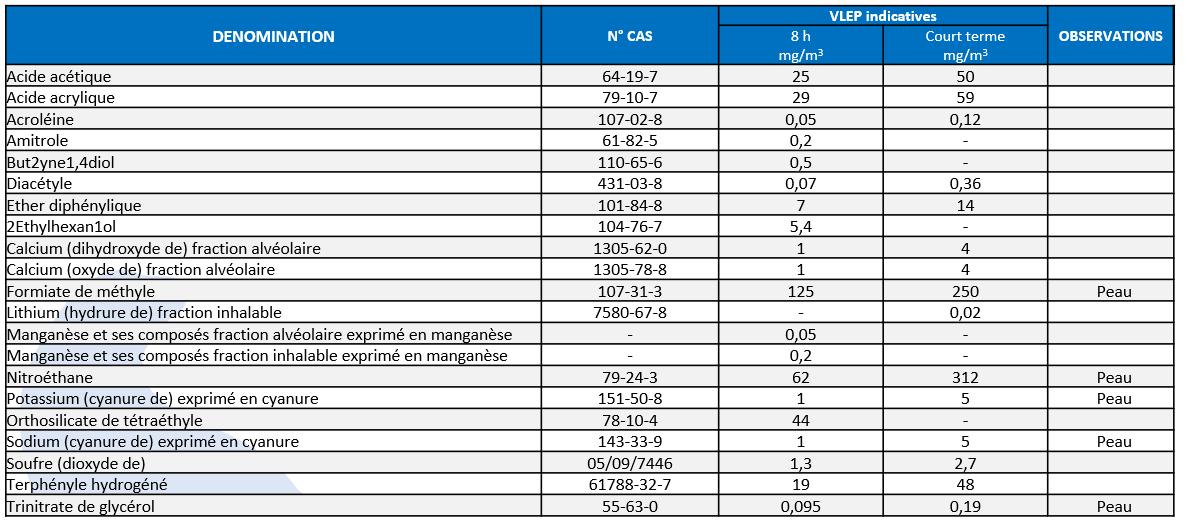
New binding and indicative OELs were introduced by Decree No. 2019-1487 of 27 December 2019 [3] and by the Order of 27 September 2019 [4]. These limit values are applicable from 1st July 2020.
List of new binding OELVs:
Addition of limit values:
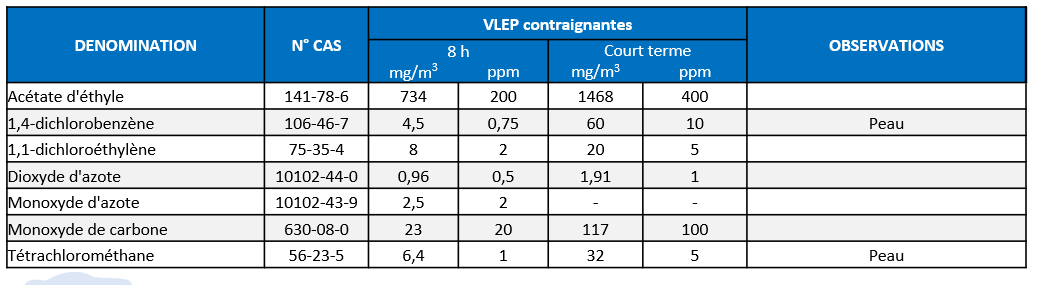
Lowering of existing limit values

List of new indicative OELVs:
Conclusion
We recommend that you, if you haven't already, should:
- investigate whether any of your processes or activities may lead to the use or emission of a substance covered by an OELV,
- assess the exposure risk for your employees in identified processes and implement appropriate prevention measures.
[1] Regulation (EC) No 1272/2008 of 16 December 2008 on classification, labelling and packaging of substances and mixtures
[2] Order of 5 January 1993 establishing the list of carcinogenic substances, preparations and processes within the meaning of the second paragraph of Article R. 231-56 of the Labour Code
[3] Decree No 2019-1487 of 27 December 2019 establishing binding occupational exposure limit values for certain chemical agents
[3] Order of 27 September 2019 establishing indicative occupational exposure limit values for certain chemical agents