
.svg)




.jpg)



In every area of economic life, digital technology now offers an opportunity to improve management processes. Environmental management is no exception. With this in mind, the digitization of hazardous waste tracking will soon be rolled out: this is Trackdéchets.
Digitizing hazardous waste tracking: the new Trackdéchets system
The government is implementing a digital platform to digitize hazardous waste tracking. This is the Trackdéchets platform. No more paper-based Waste Tracking Slips (BSD)! Long live the digital BSD!
To illustrate: in the coming months, when a company produces hazardous waste and hires a carrier to ship it to a treatment center, it will need to register the transport of this waste on the Trackdéchets platform, or ensure the carrier has done so on its behalf. Similarly, once the waste has been processed by a service provider, the corresponding information must be recorded on the platform. In short, what was once done on paper will now be done online.
It is clear that this digital transition should lead to greater efficiency in the administrative management of waste tracking.
But that is not the administration's only goal. It also aims to ensure that waste is handled by companies that hold the necessary authorizations to collect, consolidate, and/or treat hazardous waste. Every service provider must be registered on Trackdéchets in order to collect or treat hazardous waste.
In other words, Trackdéchets aims to secure the entire hazardous waste tracking chain!
The stakes are high: the goal is to prevent the emergence of new "orphan sites"—sites run by pseudo-waste treatment providers that store clients' hazardous waste without oversight and with no plans for treatment.
What are orphan sites?
Orphan sites are locations that are difficult for authorities to identify, as they are often isolated and undeclared. They store waste, which can sometimes be hazardous, until it slowly degrades naturally. Left abandoned, these sites pose a threat until the waste is removed.
How does this happen? Sometimes, shell companies pose as authorized waste treatment or recycling organizations to collect waste from producing companies. They then transport it to these isolated locations without ever addressing the final disposal of the waste.
The existence of these orphan sites raises serious public health and environmental protection concerns. Furthermore, rehabilitating such sites can be very costly for local authorities!
Remember that: " under the principle of extended producer responsibility, any waste producer is already required to manage their waste or have it managed in accordance with regulations. They remain responsible until final disposal or recovery, even when the waste is transferred to a third party for treatment (Article L541-2)."
In effect, waste-producing companies may be called upon to pay for the disposal of their waste a second time: by paying for the final treatment of waste stored at orphan sites, even though they thought they had done the right thing by entrusting their waste to companies they believed were duly authorized to treat it.
New responsibilities for companies
A decree will soon be published requiring all waste producers to enter specific information into this platform. It is expected this autumn. Given the global rollout of digitized waste tracking, enabled by Trackdéchets, it will now be easier for the authorities to monitor its proper implementation.
Within a year, the daily management of hazardous waste in companies will be handled online. Businesses will be required to record waste movements and exchanges between the various stakeholders—producers, transporters, and disposal facilities—on the Trackdéchets platform.
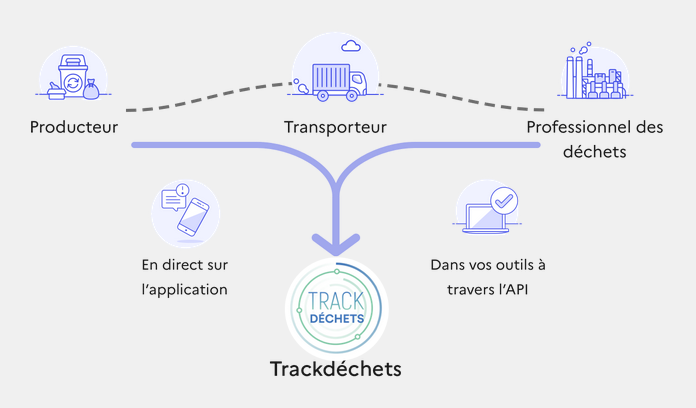
It should be noted that the Trackdéchets platform will help meet traceability requirements for certain types of waste: hazardous waste as well as waste containing persistent organic pollutants (POPs).
At the same time, it will fulfill one of the key measures of Law No. 2020-105 of February 10, 2020, regarding the fight against waste and the circular economy.
The digital transformation of waste traceability at the operational level
Entering this information into the platform requires some internal adjustments. Companies must be vigilant regarding the risk of entering incorrect information, as this data will subsequently be used by the authorities. Furthermore, since Trackdéchets is not a waste management solution, there is a risk of duplicate data entry if the producing company also wishes to track and manage its waste while remaining compliant with other relevant regulatory requirements.
Companies looking to avoid this risk without giving up on managing their waste will be seeking solutions. These must now be provided by developers of waste management software !
Ultimately, by mandating the digitalization of waste traceability, the government is encouraging companies to rethink how they currently manage their waste. The stakes are not only environmental and economic; there is also a reputational risk—what company would want to see its name associated with an abandoned site in the future? Finally, it is a matter of consistency: at a time when all companies are adopting CSR policies (which we welcome), it would be a shame if their waste management practices were not aligned with those policies.
Photo credit: Mathias Reding