
.svg)








To improve building performance and reduce energy bills, French regulations are becoming increasingly stringent. For example, the creation of thermal regulations in 1974 (and its numerous updates since) imposed increasingly strict rules on the energy performance of new buildings. More recently, the ELAN Act, passed in 2018, mandates a reduction in energy consumption for the French commercial building stock. In this context, Decree No. 2019-771 of July 23, 2019 (or Tertiary Decree) specifies the implementation procedures for this law.
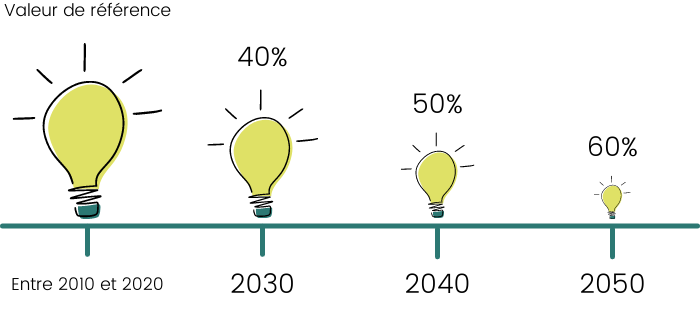
It confirms the ambitious objectives defined in the ELAN Act for 2030, 2040, and 2050:
- either reducing final energy consumption by 40%, 50%, and 60% respectively compared to a baseline energy consumption;
- or reaching a final energy consumption level set in absolute value, based on the energy consumption of new buildings in their category.
Am I affected by the objectives defined in the Tertiary Decree?
Any building, part of a building, or group of buildings housing tertiary activities (economic activity—market or non-market—that does not fall under the primary or secondary sector) may be subject to this Tertiary Decree.
Specifically, it applies to buildings, parts of buildings, or groups of buildings housing public and private sector tertiary activities that have been in operation since November 24, 2018, in the following configurations:
- a building with a floor area greater than or equal to 1,000 m² used exclusively for tertiary purposes;
- any parts of a mixed-use building that house tertiary activities and have a cumulative floor area greater than or equal to 1,000 m²;
- any group of buildings located on the same land parcel or site (multiple buildings used for tertiary purposes on the same land parcel sharing the same delivery point for a type of energy) provided that these buildings house tertiary activities with a cumulative floor area greater than or equal to 1,000 m².
The "Eco Energie Tertiaire" FAQ on the OPERAT platform specifies that buildings, parts of buildings, or groups of buildings used for tertiary purposes on an industrial site are subject to this obligation, including their office, dining, and logistics facilities, among others.
Key concepts to remember
Operators of such tertiary buildings, parts of buildings, or groups of buildings must now determine their compliance status regarding this Tertiary Decree by paying attention to the following points:
- the obligations to reduce energy consumption apply to both owners and tenants of the affected buildings;
- When tertiary activities initially housed in a building, part of a building, or a complex of buildings subject to the requirement cease, the owners and tenants who continue to conduct tertiary activities there remain subject to the obligations, even if the cumulative surface area of the tertiary activities housed falls below 1,000 m². Similarly, a building, parts of a building, or a complex of buildings not initially subject to the requirement may become so over time;
- In the event of a change in the activities of a building, part of a building, or a complex of buildings subject to this requirement:
- If it is a new tertiary activity, this new activity remains subject to the system, and the new targets are determined according to the provisions set out in the Environmental Code;
- In the event that a tertiary activity ceases and there is a change of use, the premises concerned are no longer subject to the obligations. However, the baseline energy consumption is retained on the OPERAT digital platform until a tertiary activity is potentially resumed.
I am affected by the Tertiary Decree; what should I do now?
Each year, starting in September 2021, those affected must report their consumption data to the OPERAT platform managed by ADEME, including:
- The tertiary activity or activities conducted there;
- The surface area of the buildings, parts of buildings, or complexes of buildings subject to the requirement;
- Annual energy consumption by energy type for the buildings, parts of buildings, or complexes of buildings;
- The baseline year and associated baseline consumption (due to the 2020 health crisis, those affected may declare their baseline energy consumption until September 30, 2022), by energy type. In the absence of information regarding the baseline year, it will correspond to the first full year of operation for which energy consumption data is reported on the collection and monitoring platform;
- Information on usage intensity indicators related to the activities housed, …
Based on this data, OPERAT issues an annual digital certificate. This is supplemented by an "Eco Energie Tertiaire" rating system that qualifies progress in the energy consumption reduction process defined in the Tertiary Decree, with regard to the results obtained compared to the expected targets. Here is this rating system, which includes 5 levels (from a grey leaf to 3 green leaves):

To assess compliance with the targets of the Tertiary Decree, OPERAT automatically proceeds, after collecting data for each decade, to compare final energy consumption with the two targets. If one of the two targets is met, it is considered that the targets for the decade in question have been achieved.
Additional decrees provide details on the methods for calculating and adjusting final energy consumption, the conditions for modulating final energy consumption reduction targets, and the content of the technical file required in the event of target modulation (including the completion energy audits).
Can I pool the results obtained across all or part of a property portfolio?
No target is defined at the portfolio level. However, it is possible to assess the total energy consumption across an entire portfolio and to offset the "poorer" results of certain entities that have not met one of the targets assigned to them with the good results obtained by other entities that have met one of the targets.
If one of the two targets is met for an entity within a portfolio, the most significant energy consumption surplus can be reallocated to one or more entities in that portfolio that do not meet either of these targets.
The OPERAT platform features an "Assessment of target achievement at the portfolio level" module, which allows relevant parties to run queries to evaluate their status across all or part of their portfolio.
Photo credit: Maciej Drążkiewicz