
.svg)








A memorandum dated November 24, 2016 (published in late December) sets the new framework for inspection duties carried out by authorities regarding the frequency of inspections for classified installations and equipment. It allows France to meet its inspection frequency obligations as required by various European texts (Seveso III Directive, REACH regulation, etc.).
This memorandum defines a multi-year programming plan for inspections carried out by the DREAL, DRIEE, etc. It complements the inspection handbook and national initiatives that set thematic priorities each year (e.g., inspection of cooling towers). This plan takes greater account of the relative importance of each installation, its risk level in relation to the stakes involved, and the action priorities defined at the national level.
Nature and frequency of inspections for classified installations
Inspection frequency is determined based on site typology (Seveso, IED installations, etc.). The ministry distinguishes between:
- priority classified establishments, for which an inspection at least every year is to be scheduled,
- high-stakes establishments: inspections every 3 years,
- other establishments: inspection every 7 years.
IED: Industrial Emissions Directive
RSDE: Research of dangerous substances in water
VOC: volatile organic compounds
Examples (non-exhaustive list):
1/ Priority establishments
- Upper-tier Seveso establishments
- Sites covered by headings 3120, 3130, 3140, 3210, 3430, 3450, 3510, 3520
- Sites housing facilities with significant atmospheric emissions: 300t/year or 50kg/hour of nitrogen oxides, 150t/year or 15kg/hour of dust
- Sites housing facilities with significant water discharges, for which an action plan and/or a technical-economic study is underway under the RSDE initiative
- Pig, cattle, and poultry farms subject to authorization, where the quantity of animal-derived nitrogen spread per year exceeds 50 tonnes
2/ High-stakes facilities
- Facilities Seveso Lower Tier
- Other IED facilities not classified in the "priority facilities" category
- Facilities whose annual air emissions exceed one of the following thresholds: Nitrogen oxides: 100 t/year, Total dust: 100 t/year, Non-methane VOCs: 30 t/year
- Facilities subject to authorization for which a formal notification has been issued mentioning the possibility of lethal effects impacting third parties
- Industrial collective wastewater treatment plants.
3/ Other facilities
- Facilities subject to Authorization or Registration that do not meet the criteria defined for priority or high-stakes facilities.
Reductions or adjustments to certain inspection frequencies may, however, be decided at the regional level based on the results of previous inspections, the organization implemented by the operator, and their level of risk management.
Stakes and follow-up actions for these inspections
Through this program and these visit objectives, the ministry intends to comply with European provisions and fulfill its role in terms of environmental protection.
The proportion of unannounced inspections must represent 10% of the facilities inspected each year, regardless of their regulatory regime. These unannounced inspections may be in-depth or targeted visits, or discharge checks conducted by third-party laboratories in coordination with the classified installations inspectorate.
Classified facility inspectors are responsible for monitoring facilities and ensuring compliance with the technical requirements imposed on operators. They also intervene in the event of complaints, accidents, or incidents.
While the total number of inspection visits (20,000 in 2014) has been declining since 2006 (-34%), the number of in-depth inspection visits (10,000 in 2014) remains high, reinforcing the inspection's substantive work by focusing more on high-stakes issues.

Source: Ministry of the Environment, Energy and the Sea: Inspection of classified facilities - Activity Report
With 1,250 inspectors (full-time equivalents), an average of 20,000 visits are carried out each year. Failure by an operator to comply with a formal notice to bring their facility into line with classified facility regulations can lead to various administrative sanctions: orders to deposit funds, administrative fines and penalties, ex officio work, suspension of activity, removal or closure, and the affixing of seals. Criminal sanctions may also be proposed to the Public Prosecutor.
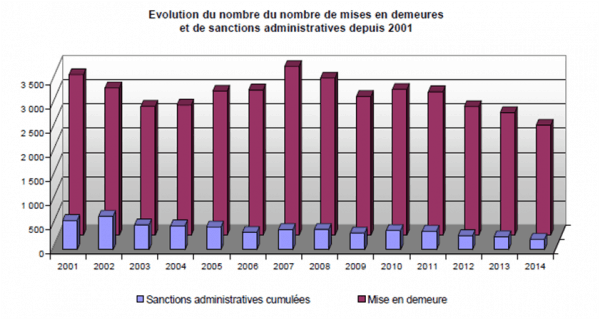
Source: Ministry of the Environment, Energy and the Sea: Inspection of classified facilities - Activity Report
It should be noted that in 12% of cases, inspection visits lead to a formal notice. Given the number of facilities in France subject to Authorization—nearly 50,000—the number of visits remains modest (20,000), but on average, one in seven visits results in a formal notice being issued to the facility operator.
Trends in classified facility inspections
For several years (see chart above), the number of inspection visits has been decreasing, while the number of inspectors has remained generally stable.
Even though the number of facilities requiring Authorization has fallen significantly in recent years, the complexity of procedures, the scope of inspectors' work, and increasing monitoring and traceability obligations have led to a gradual reduction in the time inspectors spend on-site.
The Ministry's desire to concentrate its resources on the highest-risk facilities has led it, in recent years, to adopt a new approach to ensure that other facilities are still monitored.
Thus, since 2010, certain companies subject to Declaration under ICPE regulations must have a periodic inspection carried out by an accredited body every 5 years (or every 10 years if they are ISO 14001 certified). This inspection consists of verifying the regulatory compliance of their facilities.
The operator must therefore appoint and pay for an organization to verify compliance with regulations.
It should be noted that these organizations provide the authorities with a list of the facilities they have inspected, allowing the authorities to ensure that the relevant companies are fulfilling this obligation. Furthermore, these same inspection bodies also report to the authorities the list of sites and an excerpt from their report indicating major non-conformities when:
- the inspection body has not received the operator's compliance schedule within the three-month deadline;
- the inspection body has not received a written request for a follow-up inspection from the operator within one year;
- the follow-up inspection reveals that major non-conformities persist.
Whether for "high-risk" facilities monitored and inspected by authorities every 1 to 7 years, or for other organizations where regulatory compliance verification is delegated to a third party, the operator remains responsible for its environmental impact (accidental spills, chronic pollution, etc.). Consequently, the penalties can be significant.
We believe that managing an environmental policy should not be driven by these inspections. It is not about being reactive or simply enduring the process. Instead, it is about adopting a responsible approach by using regulatory provisions (where relevant) as a foundation and a source for improving prevention and environmental protection measures. Through a pragmatic and progressive approach, it is possible to anticipate investments and improve environmental performance.