
.svg)






🔎 Key takeaways
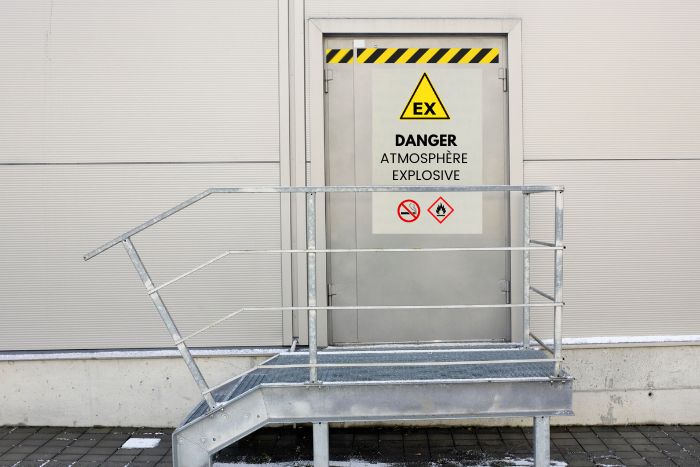
According to the INRS, an industrial explosion occurs on average every day in France. The consequences can be severe, both in terms of human life and property damage. To mitigate this risk, specific regulations known as "ATEX" have been established. From risk assessment to the delineation of ATEX zones, here is an overview of the key regulatory requirements.
Explosion risk: what does "ATEX" mean?
To describe the risk of explosion in the workplace, the acronym " ATEX" is generally used, standing for explosive atmosphere. An explosive atmosphere is a workspace where there is a risk of explosion due to the presence of flammable materials and combustibles.
Consequently, any company that stores or uses combustible or flammable products is potentially exposed to explosion risks and must comply with the applicable regulations.
Unlike a fire, an explosion is an almost instantaneous combustion that occurs following the formation of an ATEX. An explosive atmosphere is defined as a mixture of air and combustible substances (dust, solvent vapors, etc.).
For an explosion to occur, six conditions must be met simultaneously. They are illustrated in the diagram below:
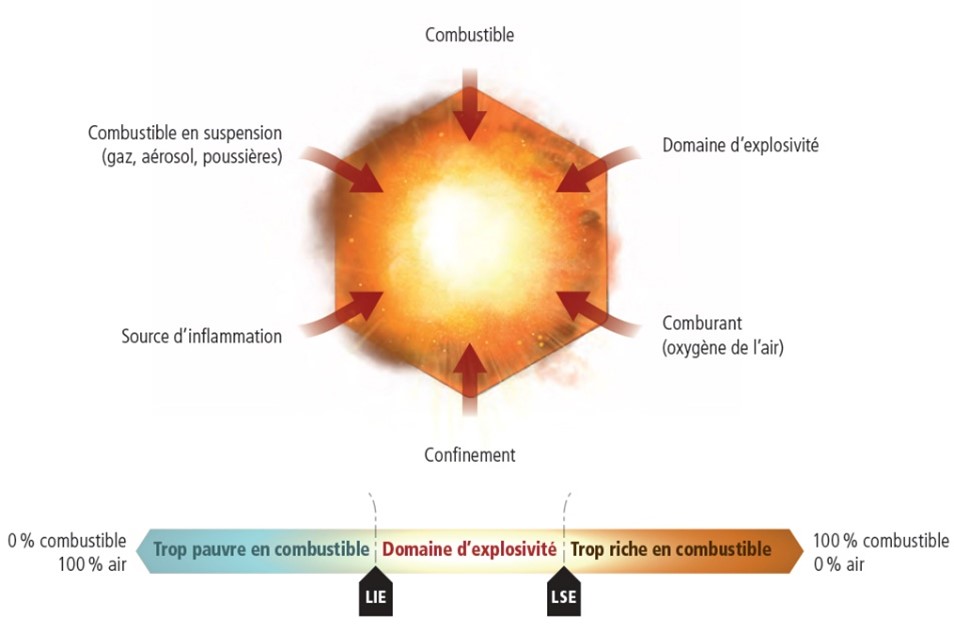
Note: confinement is not an essential condition, but it is a factor that exacerbates the explosion phenomenon.
Explosion risk: what are the employer's obligations?
Assess the explosion risk
As with all occupational risks, the employer must assess the risk of explosion. The first step is to identify the hazards through a functional analysis:
- Create an inventory of combustible products and their characteristics (density, flash point, chemical incompatibilities with other products, etc.), as well as their quantities and storage conditions;
- Analyze the processes implemented through a precise study of the facilities and workstations;
- Study the potential malfunctions: it can be useful to rely on feedback from the company or the industry sector to highlight any incidents or obstacles to "normal" operation.
- Identify the sources of ignition : all sources of ignition are detailed in the NF EN 1127-1 standard. These may include electrical sources (sparks, overheating, etc.), electrostatic sources (spark discharges, etc.), or thermal sources (cigarettes, hot work, etc.).
Please note: the risk assessment must be carried out comprehensively meaning it must be combined with the results of risk assessments for other occupational hazards identified in each of the company's work units.
The risk assessment must then enable the employer toidentify areas where explosive atmospheres may form. The purpose of this zoning is twofold:
- Visualize the risk by marking ATEX zones and workplaces containing ATEX zones with the regulatory warning sign;
- Ensure the compatibility of all equipment (electrical and non-electrical) with the type of zone.
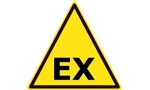
A decree dated July 8, 2003 defines the classification of locations where explosive atmospheres (ATEX) may occur, as well as the minimum requirements that must be met in those areas.
Warning: layers, deposits, and piles of combustible dust must be considered as potential sources for the formation of an explosive atmosphere.
Regulations do not precisely define the terms " frequently " and " occasionally ". However, companies may refer to the definitions adopted by certain professional organizations (Union of Chemical Industries, Petroleum Industry Safety Study Group):
- Zone 0 or 20: duration of ATEX presence > 1000 hours/year;
- Zone 1 or 21: duration of ATEX presence between 10 and 1000 hours/year;
- Zone 2 or 22: duration of ATEX presence < 10 hours/year.
The results of the risk assessment must be recorded in the explosion protection document (EPD).
Implement technical and organizational measures
Based on the results of the risk assessment, prevention and protection measures must be implemented. Their objective must be:
- Primarily, toprevent the formation of explosive atmospheres by managing the fuel and the oxidant. Examples: increasing particle size, source capture of vapors and dust, introducing an inert gas to reduce oxygen levels in the atmosphere, etc.
- If the activity does not allow for the prevention of an explosive atmosphere (ATEX) from forming, avoid ignition sources by adjusting processes and equipment, as well as by performing inspections. Examples: installing cooling systems, ensuring equipment is suitable for the environment, etc.
- limit the effects of an explosion, for example by installing explosion vents or suppression systems, or by adjusting the layout and design of the premises. Examples: compartmentalization, choosing suitable fire-resistant materials, etc.
More generally, the employer must ensure that workers in ATEX zones can work safely. In particular, they must take the necessary measures to ensure that:
- Personnel working in ATEX zones are trained on explosion risks: this training must be tailored to the worker's level of exposure;
- adequate supervision is provided;
- Workers are equipped with appropriate clothing against the risk of ignition;
Please note: the measures implemented must be reviewed periodically and whenever there is a significant change in work conditions.
Establish and update the DRPCE
Any company exposed to explosion risks must establish an explosion protection document (DRPCE). The DRPCE must be integrated into the single occupational risk assessment document, be regularly updated, and include the following elements in particular :
- The assessment of explosion risks;
- The nature of the measures taken or to be implemented to comply with regulations;
- The classification of ATEX zones, as well as a description of the areas to which minimum requirements apply in accordance with the decree of July 8, 2003;
- The procedures and rules according to which workplaces and equipment are designed, used, and maintained to ensure the health and safety of workers;
- Where applicable, the list of tasks that must be performed according to the employer's written instructions or that are subject to authorization.
Please note: the DRPCE must be prepared before work begins and be revised as soon as significant modifications, extensions, or transformations are made to the premises, work equipment, or work organization.
Ensure the compliance of equipment and protective systems used in ATEX zones
Regulations require that all equipment, electrical or non-electrical, present in ATEX zones, as well as protective systems, must comply with the technical requirements defined for each zone.
These devices and protective systems are classified into two groups:
These devices are subject to design rules as well as a conformity assessment by the manufacturer.
Good to know: equipment that complies with harmonized standards or parts of harmonized standards published in the Official Journal of the European Union (OJEU) is presumed to comply with the essential safety requirements covered by those standards or parts of standards. Notable examples include the NF EN 60079 series of standards, Explosive atmospheres, Parts 0 to 31: Equipment, requirements, zoning guidance, and protection methods.
The employer must ensure that each piece of equipment has an EU declaration of conformity, as well as a CE marking followed by:
- The identification number of the body authorized to perform the conformity assessment:
- The specific explosion protection mark "Epsilon-X" and the symbols for the equipment group and category;
- Where applicable, a mark indicating the specific explosive atmospheres for which the product is designed.
Useful resources
- Explosive atmospheres in the workplace, brochure ED 6337, INRS
- Fire and explosion in the workplace, brochure ED 4702, INRS
- ATEX risk assessment grid, tool 107, INRS
Regulatory sources
- Labor Code, articles R. 4216-31 and R. 4227-42 to R. 4227-54 (explosion prevention)
- Environmental Code, articles R. 557-7-1 to R. 557-7-9 (conformity of equipment and protective systems intended for use in explosive atmospheres)
- Order of July 8, 2003, regarding the protection of workers potentially exposed to an explosive atmosphere.
Photo credit: 75306586 @Aleksandr Volkov