
.svg)


.jpg)



Lifting equipment includes forklifts, stackers, overhead cranes, hoists, certain types of cranes, and lift tables. Let’s review the main regulatory provisions that apply, particularly the inspections they are subject to.
Furthermore, workers operating this equipment must be trained and, for the highest-risk machinery, must hold an operator authorization.
Note: We will not cover the specific regulations for elevators and freight lifts here.
What are the main mandatory inspections?
As mentioned in the introduction, lifting equipment is subject to certain inspections. These checks must be carried out by competent persons in the field. This can be internal staff, provided they possess the necessary qualifications. In practice, these are often performed by specialized companies (inspection service providers, maintenance firms, etc.).
Note: Some equipment is exempt. For example: pallet jacks that only lift the load just high enough to move it by clearing the ground.
The following table outlines the main inspections:
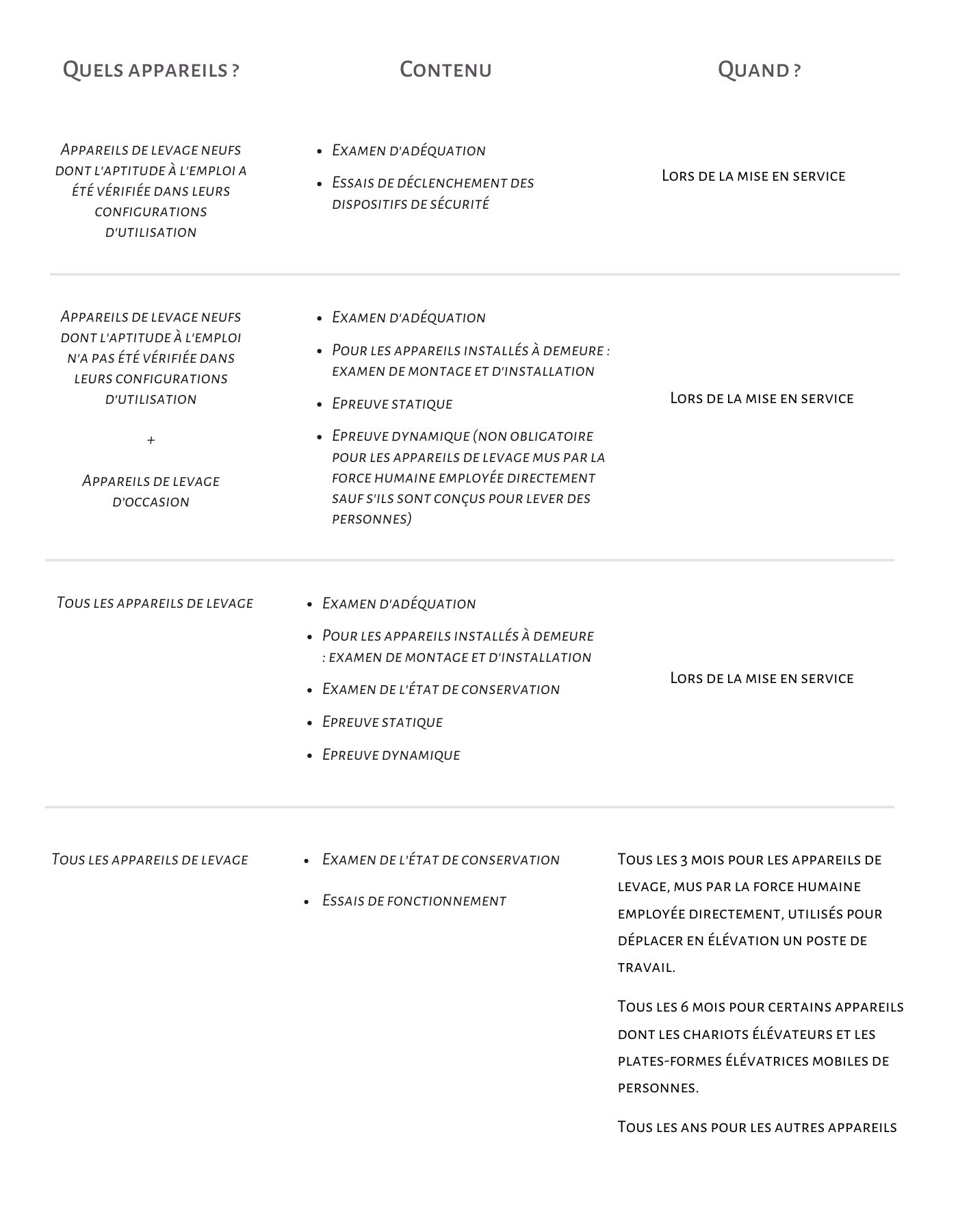
The suitability assessment consists of verifying that the lifting equipment is appropriate for the planned work and the risks to which workers are exposed, and that it will be installed and used in accordance with the manufacturer's instructions.
Remember to provide the inspector with loads that allow for testing at the equipment's WLL (Working Load Limit).
Other specific inspections are required, particularly when the equipment is moved to a new site.
Note: lifting accessories (slings, straps, spreader beams, etc.) are also subject to inspections.
Maintenance logs for lifting equipment
A maintenance log must be created and kept up to date for every lifting device. For each operation, the date of the work, the names of the individuals or companies that performed it, the nature of the operation, and, if applicable, its frequency must be recorded.
Note: This log does not necessarily have to be in paper format. It can be maintained electronically (e.g., CMMS).
Driving authorization for high-risk equipment
For certain high-risk equipment, workers must hold a driving authorization.
Which lifting devices are affected?
- tower cranes;
- mobile cranes;
- vehicle-mounted loader cranes;
- self-propelled industrial trucks with a ride-on operator;
- mobile elevating work platforms;
- remote-controlled or ride-on construction machinery
How is it issued?
The driving authorization is drawn up and issued to the worker by the head of the establishment. It is conditional upon:
- the completion of a medical fitness examination by the occupational physician,
- a verification of the operator's knowledge and skills for the safe operation of the work equipment (e.g., CACES).
- and knowledge of the premises and the instructions to be followed at the site(s) of use.
Note: Employees holding this authorization must receive enhanced individual monitoring as part of their medical follow-up.
Training workers
Operating lifting equipment is reserved for workers who have received adequate training.
This training is designed to provide drivers with the knowledge and skills necessary for safe operation.
Its duration, content, and renewal requirements must be tailored to the specific equipment involved. It may be provided by the employer or delivered by a specialized training organization.
Conclusion
We recommend that you:
- inventory all of your lifting equipment;
- ensure that the relevant personnel are trained and, for equipment requiring it, hold a valid operating permit;
- verify that:
- this equipment undergoes regular inspections,
- corrective actions are implemented,
- these inspections are recorded in your inspection schedule,
- and that a maintenance log is kept.
Note: when renting equipment, ensure:
- that the aforementioned inspections have been completed by obtaining copies of the initial commissioning report and the most recent periodic inspection report
- and that you have the instruction manual.
Photo credit: Pickawood